Profile optimization, local citation building and reviews - the three signals that decide who Austin sees first.
When someone searches for a service near them, Google shows a map with three businesses above the normal results. That block gets a large share of the clicks, and for many local searches it is effectively the entire first page.
Getting into it is a different discipline from regular SEO. Google weighs your Google Business Profile, your proximity and relevance, the consistency of your business details across the web, and your reviews - factors that have little to do with your website's content.
For an Austin business this is usually the fastest visibility available. Profile optimization and citation cleanup can move things in weeks rather than months, and a steady flow of reviews compounds from there.
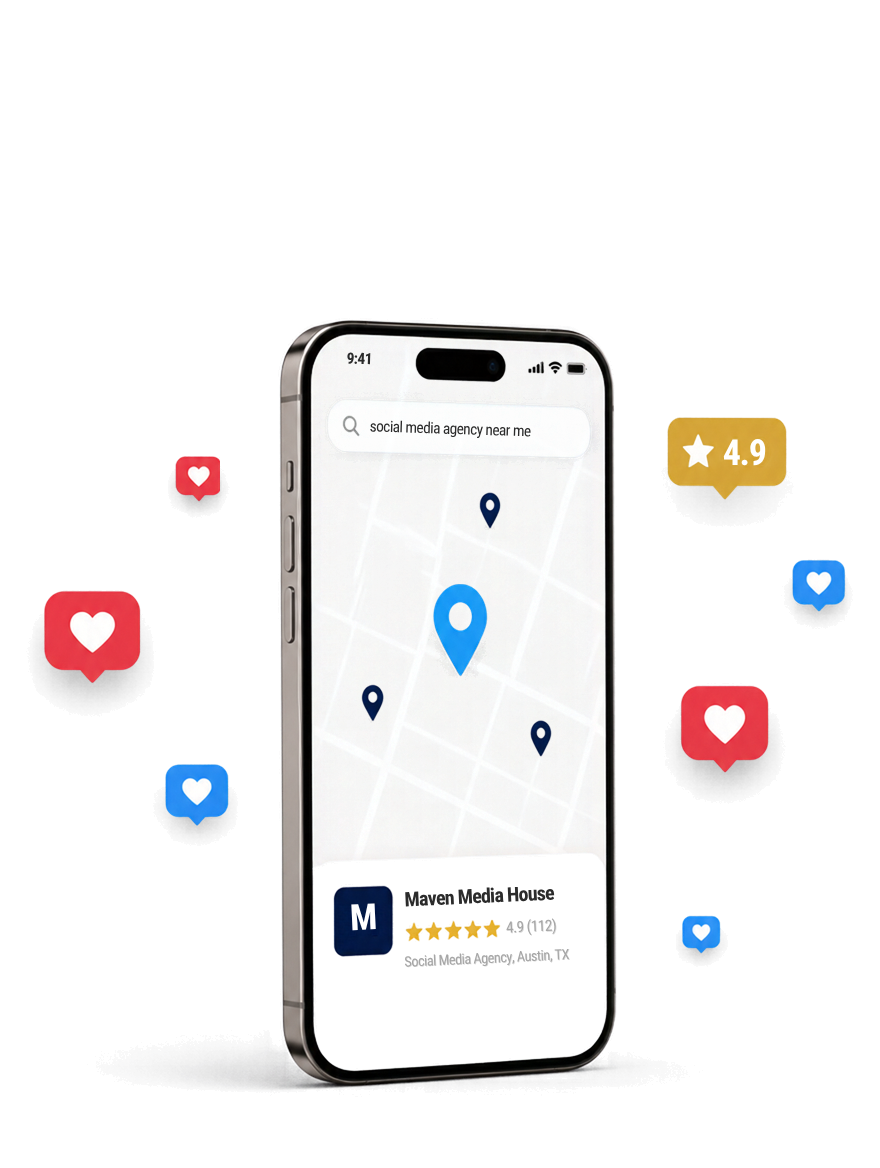
Google publishes the factors behind local results, and there are only three: relevance, distance and prominence. Relevance is how well your profile matches the search. Distance is how far you are from the person searching. Prominence is, in Google's words, "how well-known a business is" - which it says draws on "how many websites link to your business and how many reviews you have."
Distance is fixed. You can't move your pin, and the businesses closer to a given searcher start ahead of you for that search. That leaves two factors worth spending money on, and they respond on completely different timelines.
Relevance moves in weeks. It lives almost entirely inside your Google Business Profile - primary category, service list, description, attributes, hours, photos. These are free fields, and most Austin profiles we audit have half of them empty.
Prominence moves in months, and only if the work is steady. Citations, reviews and local links compound. There's no version of this that works as a one-off project.
We wrote the full breakdown of how the three factors interact in how to rank higher on Google Maps, including why a competitor further away can still outrank you.
A citation is any mention of your business name, address and phone number on a site that isn't yours. Directories, chambers, trade associations, review platforms, data aggregators. They're the least interesting part of local SEO and one of the most reliable, because they feed prominence directly and almost nobody maintains them properly.
The short version
Not every listing is worth the hour it takes to claim. We sort them into four tiers and work down:
LocalBusiness schema. These are the reference record everything else is checked against.What we skip: paid listing networks that generate hundreds of identical low-quality profiles. They inflate a count on a report and do nothing for prominence.
Mismatches don't arrive deliberately. You move offices, change a number, someone lists you as "Co." instead of "Company", an old suite number lingers on a directory nobody has looked at in four years. Each one is a small reason for Google to be less certain which record is correct, and that uncertainty is subtracted from the factor you were trying to build.
It costs you twice, because customers hit the same records. A disconnected number on a directory page is a lost call that never appears in any report you'll see.
Austin is a hard local market for a specific reason: it grew fast, and the competitive set in most service categories is larger and better funded than the city's size suggests. For a lot of searches you're not competing with the shop down the road, you're competing with a regional operator running paid alongside a mature profile.
Three things that follow from that:
If you serve customers at their locations rather than yours, your service area is set in the profile - but the physical pin still anchors how far you realistically rank, whatever radius you enter.
We claim and fully complete your Google Business Profile - categories, services, description, hours, photos and posts - because completeness is itself a ranking factor most businesses ignore.
We make sure your name, address and phone number appear identically everywhere they exist online, and fix or remove the inconsistent listings that undermine trust.
We put a simple, repeatable system in place for requesting reviews from happy customers, and help you respond to them - both volume and recency matter.
Where relevant we build location or service-area pages, then track map-pack positions so you can see movement rather than guess at it.
It helps, but service-area businesses can rank too by defining the areas they serve. Google does require a genuine business presence rather than a virtual mailbox.
There is no magic number - what matters is a steady flow of recent, genuine reviews. Consistency over time beats a sudden burst, which can look suspicious.
Faster than most SEO. Profile and citation improvements often show within a few weeks, with reviews and authority compounding over the following months.
Any mention of your business name, address and phone number on a site that isn't yours - directories, chambers, trade associations, review platforms and the data aggregators that syndicate to them. Google treats them as part of how well-known your business is.
Fewer than most citation packages sell. Accuracy beats volume: a dozen correct listings on sites that genuinely describe your business do more than hundreds of scraped duplicates, which can actively muddy which record Google trusts.
No. Listings drift as numbers, addresses and suite details change, and stale records get re-syndicated. We re-check on a schedule, which is the step most one-off citation projects leave out.
Tell us what you're working on and we'll come back with a straight answer on whether we can help.
Start a project → Digital Marketing Agency